
Arrest History in Lee County
Lee County arrests may begin with the Sheriff's Office, Giddings Police Department, Lexington Police Department, a Texas DPS trooper, a constable, or another authorized agency. The arresting officer creates the incident or probable-cause report. Lee County Jail then creates a separate booking and custody record. A magistrate adds warnings and a bond order. If prosecutors file a charge, the proper clerk opens the court file.
These records do not form one local database. A sheriff report cannot supply a Giddings officer's narrative, and a jail entry cannot establish the court's final decision. The DPS public product is a narrower statewide repository view that generally requires a qualifying reported disposition before related arrest data becomes publicly disseminable. Recent arrests may therefore appear by phone or in a weekly report before they appear anywhere else.
The official Lee County Sheriff site displayed its Inmate Booking module as offline for maintenance when inspected on August 8, 2026.

That notice makes the jail phone, VINELink, and a focused booking-record request the dependable official fallbacks.
Lee County Booking Module Fallbacks
When the online roster is unavailable, call Lee County Jail at 979-542-2800 for current custody information. The main number serves jail and nonemergency contact around the clock. Use VINELink for custody status and notifications when the local agency feed supports the event. For a record rather than a live status check, submit a precise request to the Sheriff's Office.
The module's search controls and result fields could not be inspected while it was offline. Do not assume that a local profile contains a photograph, release date, or a complete charge list. Ask the jail what it can confirm, and use the court clerk for filed charges. Absence from a current custody tool does not show that no past arrest occurred.
The sheriff's official jail page gives the current jail contact and operating rules.
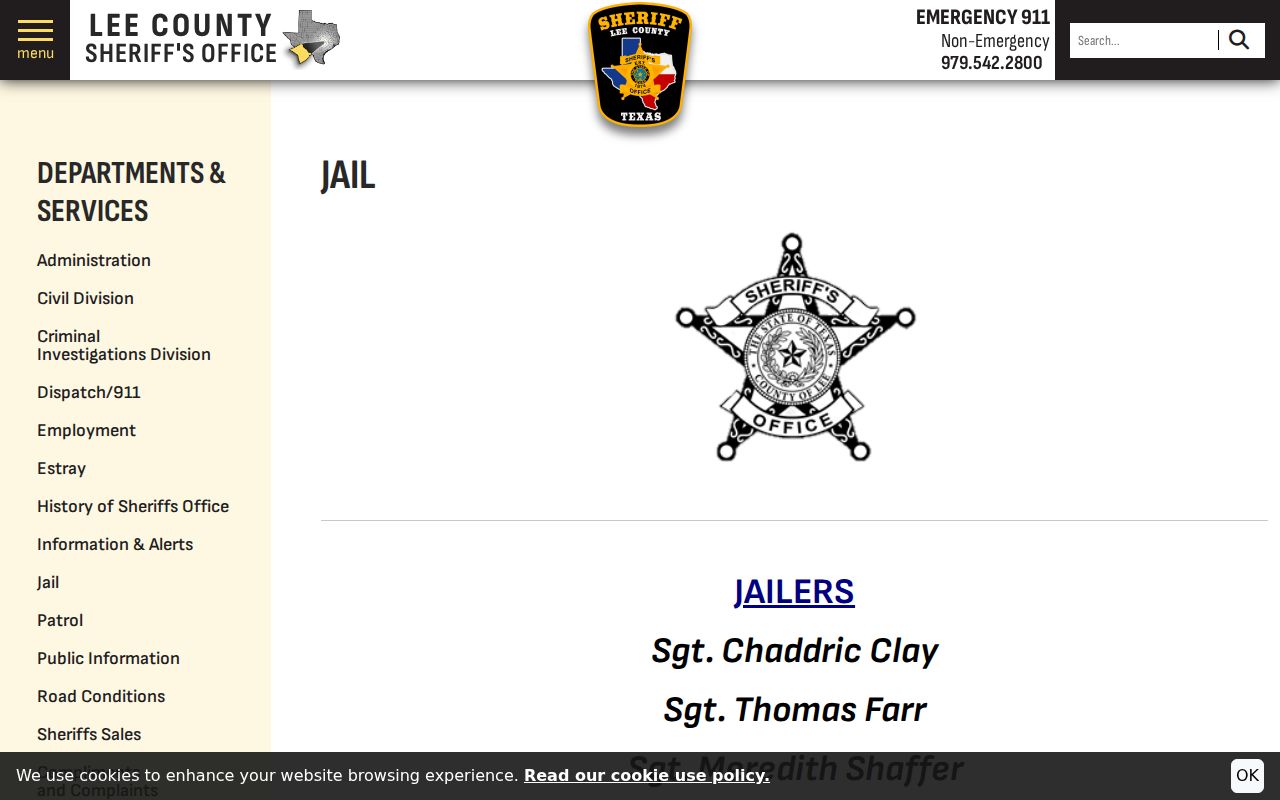
The jail page is a custody source, not a replacement for the arresting agency's narrative or the clerk's signed disposition.
Note: Lee County research found no verified sheriff or local police mobile app with an official booking-search listing.
How to Look Up Lee County Arrests
A complete Lee County arrest lookup follows the event across custodians. Begin with what is most current, then confirm what was filed and how the charge ended.
- Fix the likely agency, date range, and place. Review the Sheriff's dated weekly reports for county incidents, then call the jail because the booking module was offline.
- Use VINELink for custody alerts. Ask Lee County Jail to confirm current custody, but do not treat a roster result as a conviction record.
- Request the arrest or incident report from the agency that created it. Use the sheriff form for a deputy's report and the city form or town contact for a city officer's report.
- Check the correct court after charges are filed. The District Clerk handles felonies, the County Clerk handles Class A and B misdemeanors, and municipal or justice courts keep lower-level matters.
- Search the Texas DPS public criminal-history portal for its statewide public slice, or use fingerprint personal review for your own fuller record. Compare the booking charge with the filed accusation and signed disposition because reporting delays can explain a conflict.
For a Giddings arrest, request the officer's narrative from Giddings Police even if Lee County Jail handled intake. Lexington police records likewise stay with the town, while county deputies' reports go to the Sheriff.
Request Lee County Arrest Reports
The Sheriff's Office accepts public-information requests by mail, fax, and email. Send mail to P.O. Box 98, Giddings, TX 78942, fax 979-542-1446, or email info@leecountysherifftx.org. Savana Lehmann is the listed information contact at 979-542-2800, extension 226. Submission is free, but lawful production charges may apply. No flat sheriff report fee was found in official sources.
Describe an identifiable existing record. Give a date or time range, location, incident number if known, and the precise item sought. The office warns that blanket or open-ended requests will not work and that it has no duty to create a new document. State whether electronic inspection is acceptable and ask for an estimate if cost matters.
Lee County Sheriff's Office
2122 FM 448
Giddings, TX 78942
979-542-2800
Public office hours: Monday-Friday, 8 a.m.-5 p.m.
The Sheriff's public-information page displays the mail, fax, and email routes and its custodian limits.
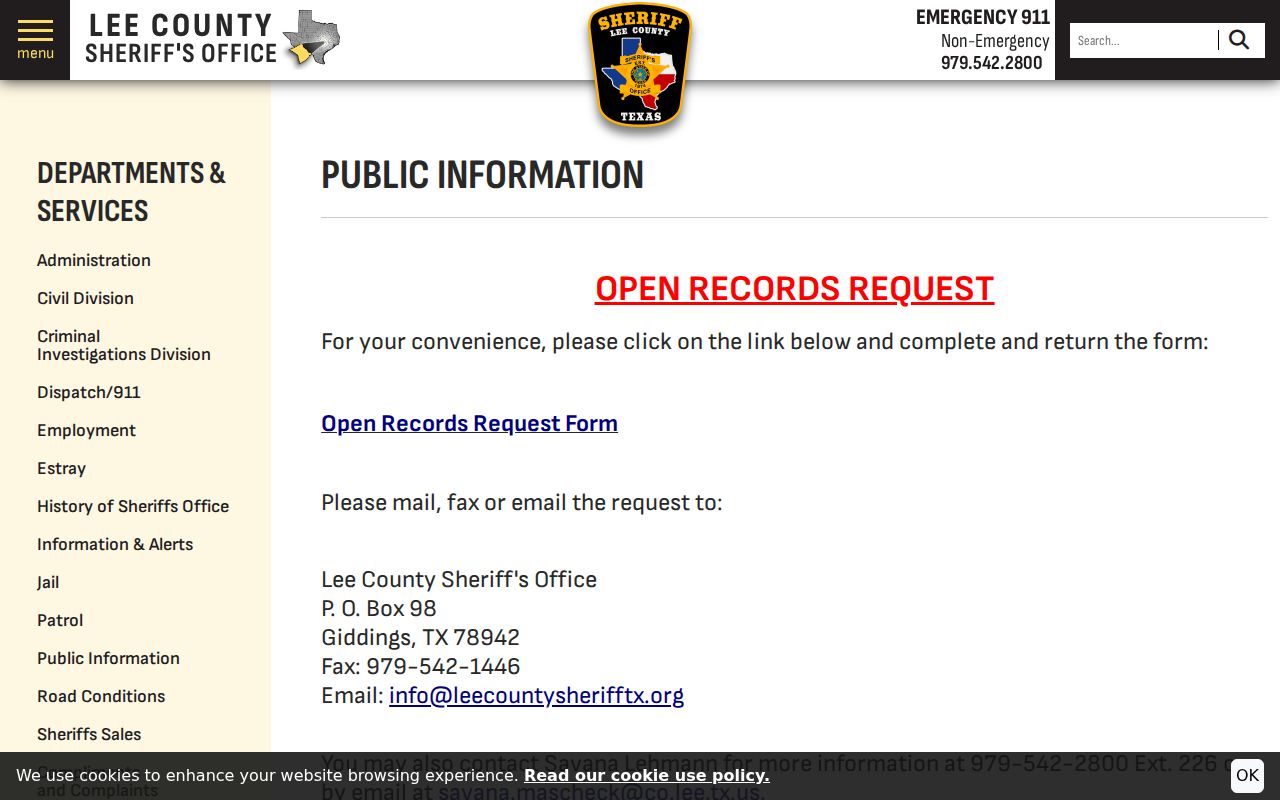
That custodian warning prevents a common error: the Sheriff cannot provide a DPS rap sheet, lab report, autopsy, or city-police record it did not create.
What an Arrest Record Shows
“Arrest record” can refer to an officer's report or a jail booking entry. Lee County's agency report may include the event, officer, alleged offense, probable-cause narrative, property, evidence, and warrant information. Jail intake adds custody data. Public copies may redact driver-license and Social Security numbers, juvenile information, medical facts, sensitive victim details, and material tied to an active investigation.
| Incident or Booking Number | The agency key used to retrieve the report or intake event. |
|---|---|
| Date, Time, and Place | When and where the arrest or jail intake occurred. |
| Arresting Agency | The deputy, city department, state unit, or other agency that made the arrest. |
| Intake Charges | Allegations entered at booking, which may differ from later filed or final charges. |
| Bond | The amount, type, or court conditions recorded at that point in the case. |
| Fingerprint Control | The transaction or tracking data used to send a reportable arrest event to DPS. |
| Booking Photo | An intake image subject to Texas release limits and agency review, not a guaranteed public field. |
| Custody or Release | The status or release date held by the jail, subject to later change. |
Texas Code of Criminal Procedure Article 2.139 limits booking-photo release in specified situations. Lee County does not currently provide a dependable official public booking-photo gallery, and no person's photograph or name is republished here.
Lee County Booking at FM 448
At Lee County Jail, booking can include identity questions, a property inventory, photograph, fingerprints, charge or warrant entry, health screening, classification, and magistration. Fingerprints link a reportable arrest to a tracking-control number that can later receive a prosecutor and court disposition. A magistrate gives required warnings and addresses bond without unnecessary delay.
Bond may be cash, surety, or personal bond. A judge can also impose conditions or no bond where law allows. Call the holding office before trying to post because the amount, accepted instrument, and proper office depend on the warrant and court. A booking is administrative intake, not a judicial ruling on guilt.
The flow is local and concrete: Arresting Agency › Lee County Jail Booking › Magistration › Prosecutor Review › Court Filing.
Recent Arrests and Booking Logs
Lee County's official recent-activity fallback is the Sheriff's weekly report index. Reports summarize dated calls, general locations, arrests or bookings, warrant service, aid to other agencies, and weekly operating totals. They are useful for narrowing a time window or identifying which agency may have acted. They are not individual rap sheets and do not replace a booking file.
The booking module was still marked offline at the documented inspection. That means no stable live roster fields can be promised. A weekly report may omit a name by design, and a person who has been released may not appear in a current custody tool. Call the jail or submit a specific records request when the report does not answer the question.
The District Clerk's current criminal dockets are the felony court follow-up after prosecutors file a case.
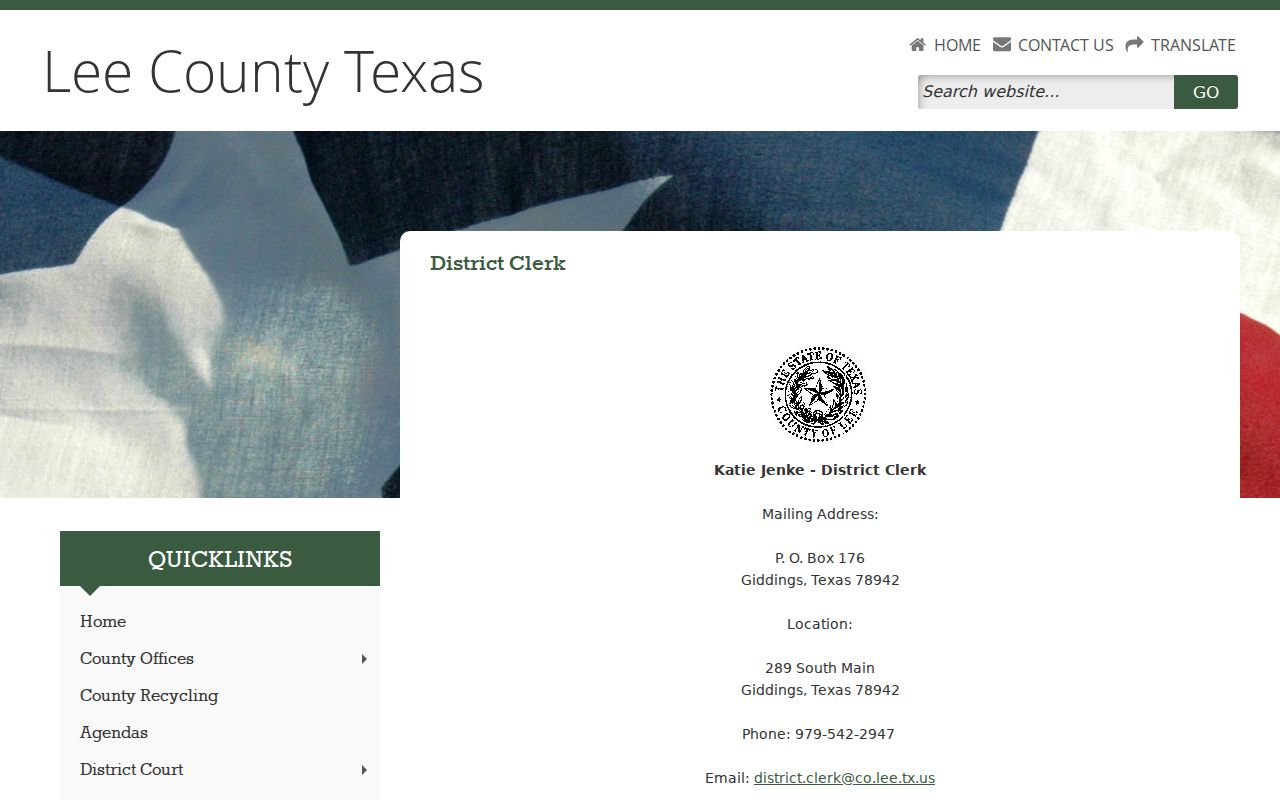
The docket can connect a booking to a cause number and court setting, but the signed judgment is still needed for the result.
Lee County Weekly Arrest Reports
A June 1 through 7, 2026 weekly report illustrates the local format. It covered highway and county-road calls, warrant service, assistance to Giddings Police and DPS, a jail-lobby surrender, domestic-disturbance arrests, crash work, and routine county calls. The report also counted 77 deputy-initiated traffic stops, 38 security checks, and 12 animal or loose-livestock calls.
Those totals describe one operating week. They are not an annual crime rate and should not be used to infer a named person's history. Lee County covers more than 629 land square miles, and its U.S. 77 and U.S. 290 corridors shape much of the visible enforcement work. For year-to-year agency statistics, use an official DPS crime report or the FBI Crime Data Explorer with the agency and year stated.
Note: A weekly sheriff narrative helps locate an event, but it cannot show every arrest, charge change, or court outcome.
Arrests vs Convictions
Lee County arrest records prove that an arrest or intake event was recorded. A conviction requires a court finding and signed judgment. The two records have different creators, fields, and outcomes. Charges can be declined, amended, reduced, dismissed, deferred, tried, or resolved by plea after the booking entry was made.
| Point | Arrest Record | Conviction Record |
|---|---|---|
| Creator | Arresting agency and Lee County Jail | The court and clerk |
| What it establishes | An arrest or booking occurred | The court entered a finding of guilt |
| Where to request | Creating police agency or Sheriff/Jail | District, County, municipal, or justice clerk |
| Possible later result | Release, no filing, dismissal, or a court case | Sentence, appeal, nondisclosure, or qualifying expunction |
Use the Lee County criminal court case record to confirm the filed charge and outcome. A DPS result may help show a reported statewide cycle, but it does not supply every pleading or event in the local file.
Note: An arrest is not proof of guilt, and a booking may end without a filed charge or conviction.
Lee County Arrests Reach DPS
For a reportable Lee County arrest, booking staff take fingerprints and transmit identifiers, the arrest event, charges, and a tracking-control number to the Texas Department of Public Safety Crime Records Division. Prosecutors and clerks later report their actions so DPS can match the arrest cycle to a dismissal, deferred adjudication, acquittal, or conviction.
Timing and old paper records can create gaps. A jail entry may exist before a court case is filed. The intake charge can differ from the final charge. A disposition may remain unmatched to an older arrest cycle. For self-review, DPS fingerprint review is stronger than a name match because the prints resolve identity. If a disposition is wrong or missing, obtain a certified court record and work with the contributing agency or court as well as DPS.
The official Lee County Clerk page shows the local counter that maintains county-level misdemeanor court records.
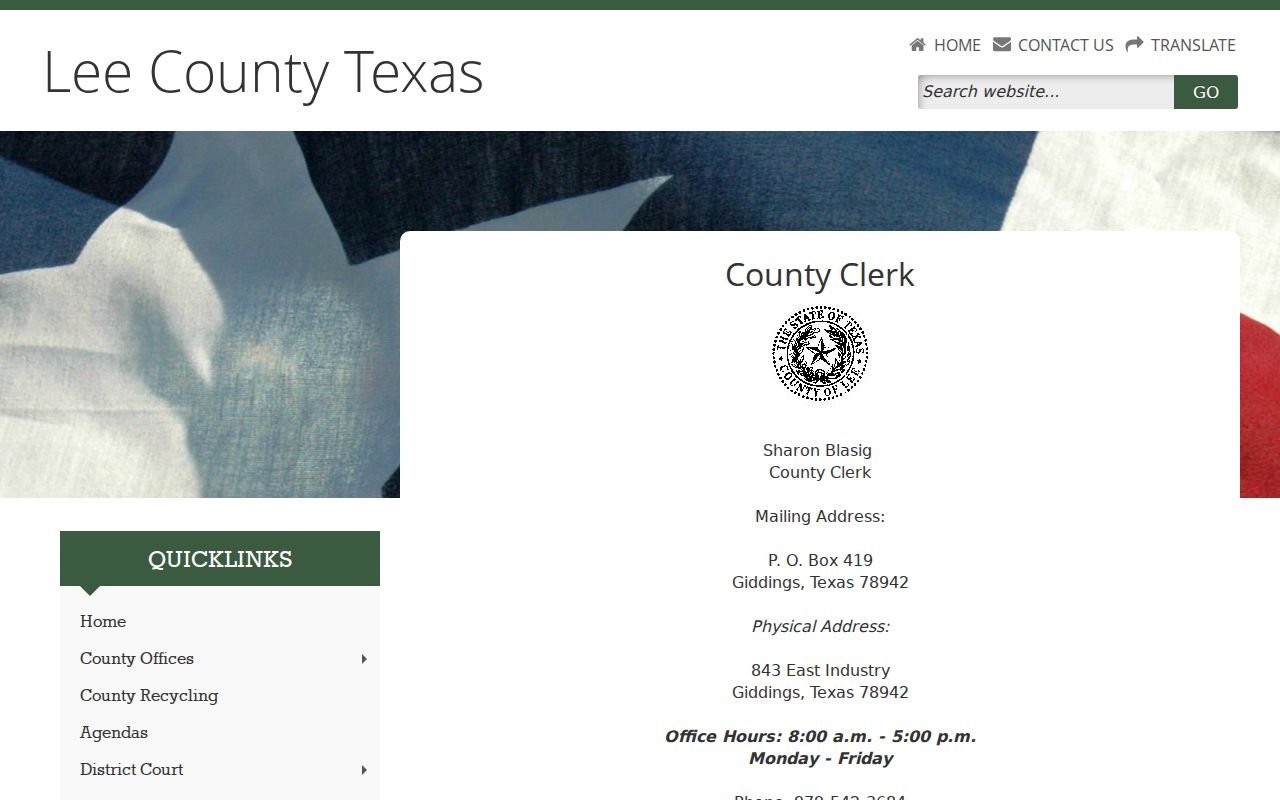
That clerk record supplies the court result that a booking entry alone cannot establish.