
Criminal Cases in the Lee County Courts
Lee County criminal court cases are divided by charge level. The 21st and 335th Judicial District Courts hear felonies, and the District Clerk keeps those files. Class A and Class B misdemeanors are filed with the County Clerk. A city municipal court or the correct justice court holds fine-only cases, local ordinance matters, citations, and some court-issued warrants. A search at the wrong counter can therefore miss a live case even when the name and date are right.
The charging document identifies the court path. An indictment generally places a felony in district court. An information commonly starts a misdemeanor prosecution. The same event can also produce an arrest report and a jail record, but neither replaces the court file. For the prosecution record, use the clerk that serves the court named on the cause number.
The official Lee County district-court page shows the local courts and current contacts. Its captured view also shows why the actual court office, rather than a broad web search, is the right authority for a setting or filing.
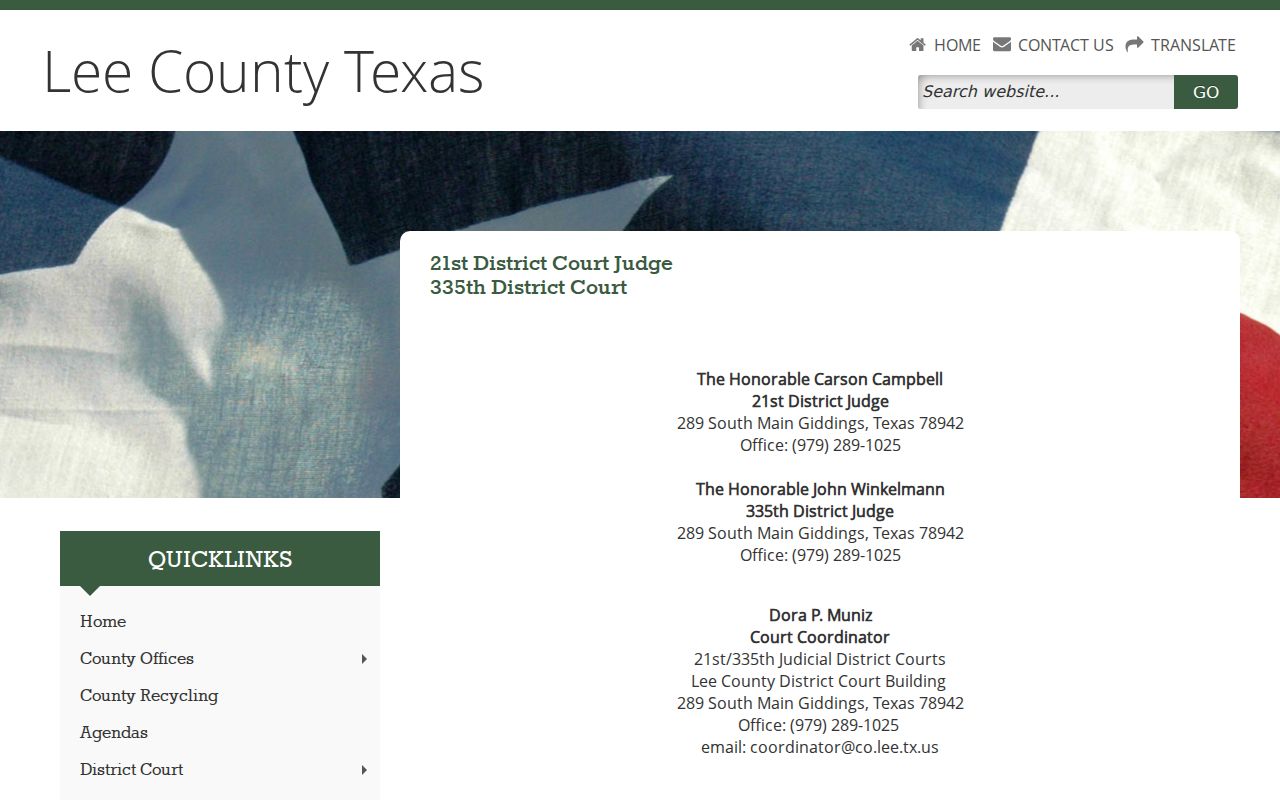
The court page places the felony venue in Lee County's separate District Court Building, not at a generic courthouse counter.
Find Lee County Criminal Dockets
The Lee County District Clerk posts current criminal docket PDFs for the two district courts. These files are date-specific calendars. They can show a cause number, offense label, indictment date, docket type, attorney, bond notation, hearing time, judge, and comments such as an interpreter need. They are useful when a person already knows the likely court date or wants to see what is set for a given call.
A posted docket is not a complete name index. It may change before the court calls the case, and it is not a judgment list. If a name is absent, ask the District Clerk to search by name or cause number. Older paper matters and documents that are not part of a current setting may still be available from the clerk. Ask for the register or docket sheet when the goal is a procedural history rather than one day's calendar.
Note: A docket offense is the filed allegation at that stage, not a finding that the person committed it.
How to Search Case Records
Start with the jurisdiction, then use the best identifier available. Lee County's posted district dockets work differently from a general party-name portal, so a careful search uses both the online calendar and direct clerk contact when needed.
- Identify whether the matter is a felony, a Class A or B misdemeanor, or a fine-only case. That choice points to the District Clerk, County Clerk, municipal court, or justice court.
- Open the District Clerk's current criminal docket links when a district-court date is likely. Scan the correct court and date for the name or cause number.
- Record the cause number, court, offense label, docket type, and hearing date. These details help the clerk locate the full Lee County criminal case file.
- Contact or visit the right clerk for the docket sheet, indictment or information, orders, plea papers, judgment, sentence, and any needed certification.
- Compare the signed disposition with any state repository result. Use re:SearchTX only as a document-access supplement because it is not a complete public criminal-name index.
The local docket inventory offers the fields below. Blank or missing values should be confirmed with the clerk instead of inferred.
| Search Detail | Format | Use | Limits |
|---|---|---|---|
| Court and docket date | PDF heading | Selects the district and calendar | Only the posted setting |
| Cause number | Numeric display | Best clerk lookup key | Must match the correct court |
| Name display | Calendar text | Locates a listed party | Not a complete historical index |
| Offense and indictment date | Text and date | Distinguishes similar cases | May not be the final offense |
| Docket type and hearing time | Setting label | Explains the scheduled event | Subject to change until call |
Lee County Dockets vs re:SearchTX
The local docket and re:SearchTX answer different questions. Lee County PDFs show scheduled district-court business and local columns. The state platform supports access to e-filed court documents based on registration, user role, document availability, and possible charges. It must not be described as one free statewide trial-court criminal-name database. State research expressly notes that its public corpus is not a complete criminal collection.
Use the Lee County docket first for a known local setting. Use the clerk for a complete file, certified copy, older matter, or a final judgment. re:SearchTX may help locate an available e-filed document, but a missing result does not prove there is no Lee County criminal court case. This comparison matters most when names are common or a recent filing has not reached every system.
The state-hosted Lee County rules page collects local rules and standing orders for the district courts.
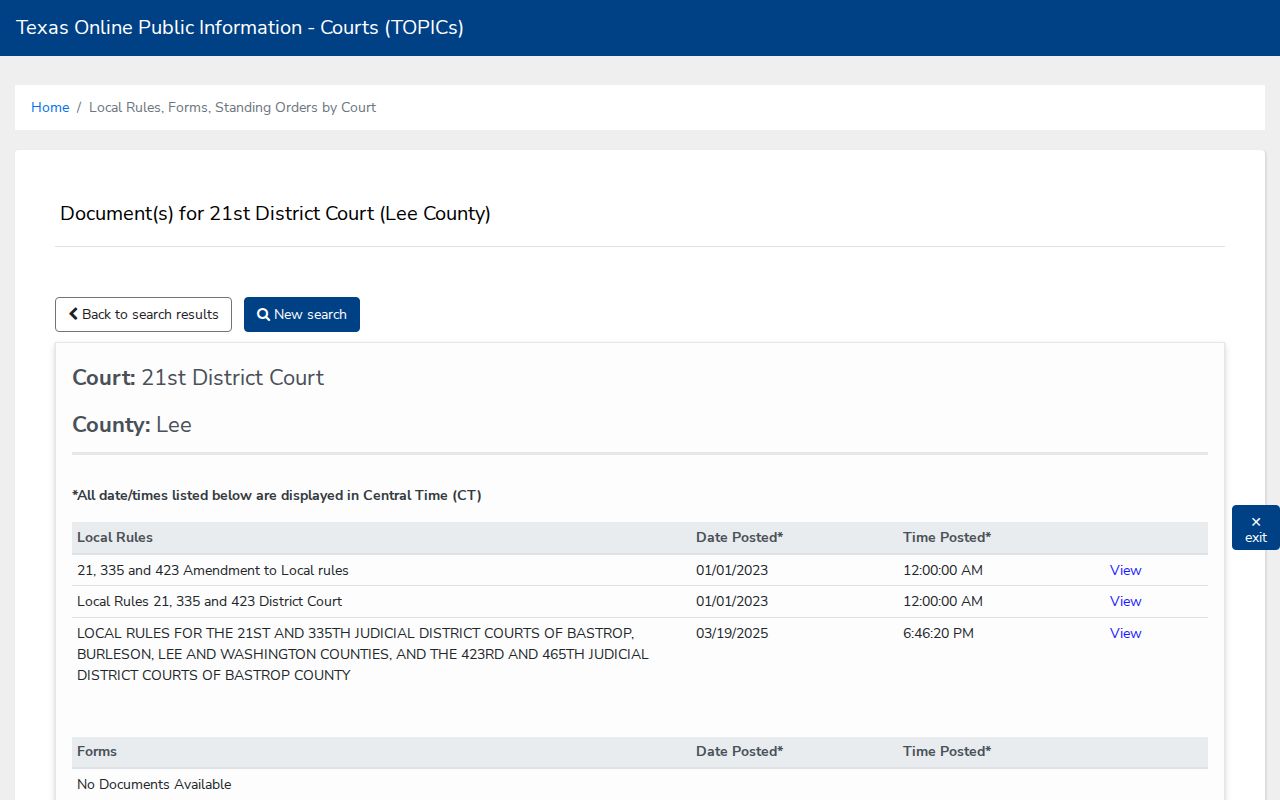
Those orders include current court-specific rules, including a 2025 order on phones and electronic devices, so visitors should check them before attending.
What the Case File Shows
A Lee County criminal case file documents the prosecution after a charge reaches court. It can contain the formal accusation, scheduled events, motions, orders, plea papers, judgment, and sentence. Each document has a different function, so the signed disposition deserves more weight than a short calendar label.
| Cause Number and Court | The unique local case key and the district, county, municipal, or justice court that holds it. |
|---|---|
| Charging Document | The complaint, information, or indictment that states the filed allegation. |
| Docket Entries | A running record of filings, settings, motions, orders, and other court events. |
| Hearing Details | Dates, times, docket types, counsel, bond notes, and local calendar comments. |
| Disposition and Judgment | The signed result, such as dismissal, acquittal, deferred adjudication, or conviction. |
| Sentence and Conditions | Confinement, fine, restitution, community supervision, or other terms the judge imposed. |
For a result that may affect an arrest-cycle entry, request a certified judgment or dismissal. It gives the contributing court and Texas DPS a reliable document if a repository disposition is missing or wrong.
Read Lee County Criminal Docket Fields
Several local labels need context. “First Appearance” and “Pre-Trial Matters” describe the kind of setting, not the outcome. “PR Bond” means personal bond, a release based on a promise and conditions rather than a commercial surety. A bondsman's name points to a surety arrangement. Interpreter or companion-setting comments help court staff manage the calendar and do not decide guilt.
An indictment date marks when the grand jury's formal accusation entered the felony process. The offense column may later differ from the signed judgment because prosecutors can amend, reduce, or dismiss allegations. “Deferred adjudication” is not the same as a conventional final conviction, while “acquitted” and “dismissed” also have distinct meanings. A clear Lee County court record search follows the cause number from the calendar to the signed order.
- Disposition
- The reported outcome of a charge.
- Arraignment
- The stage when the charge and plea are addressed.
- Personal bond
- Release based on a promise and court-set conditions.
- Deferred adjudication
- A Texas outcome in which adjudication is deferred during community supervision.
Stages of a Criminal Case
A Lee County criminal court case starts only after the justice process moves beyond the initial arrest. A magistrate gives warnings and addresses bond without unnecessary delay. The prosecutor then decides what charge, if any, to file. Felony review may include a grand jury and indictment. Misdemeanors commonly proceed by complaint and information.
Case flow: Charges Filed › Arraignment › Pretrial › Plea or Trial › Disposition › Sentencing
Pretrial work can include discovery, motions, bond questions, and negotiated plea talks. A trial resolves contested guilt. The judgment and sentence document the court's decision. An appeal, motion to revoke, or later order can add new entries, so the latest signed record matters. For the arrest and intake side of the same event, the county's arrest history channels explain the separate agency and jail records.
Lee County Criminal Case Prosecution
Lee County has an unusual prosecution structure. It has no separate district attorney. The County Attorney represents the state in misdemeanors and also prosecutes felonies in district court, presents cases to the grand jury, and works with law enforcement. That does not make the prosecutor the custodian of the public court file. Discovery and prosecution work stay distinct from the clerk's docket, orders, and judgment.
The official County Attorney page lists both felony and misdemeanor duties as well as current office information.
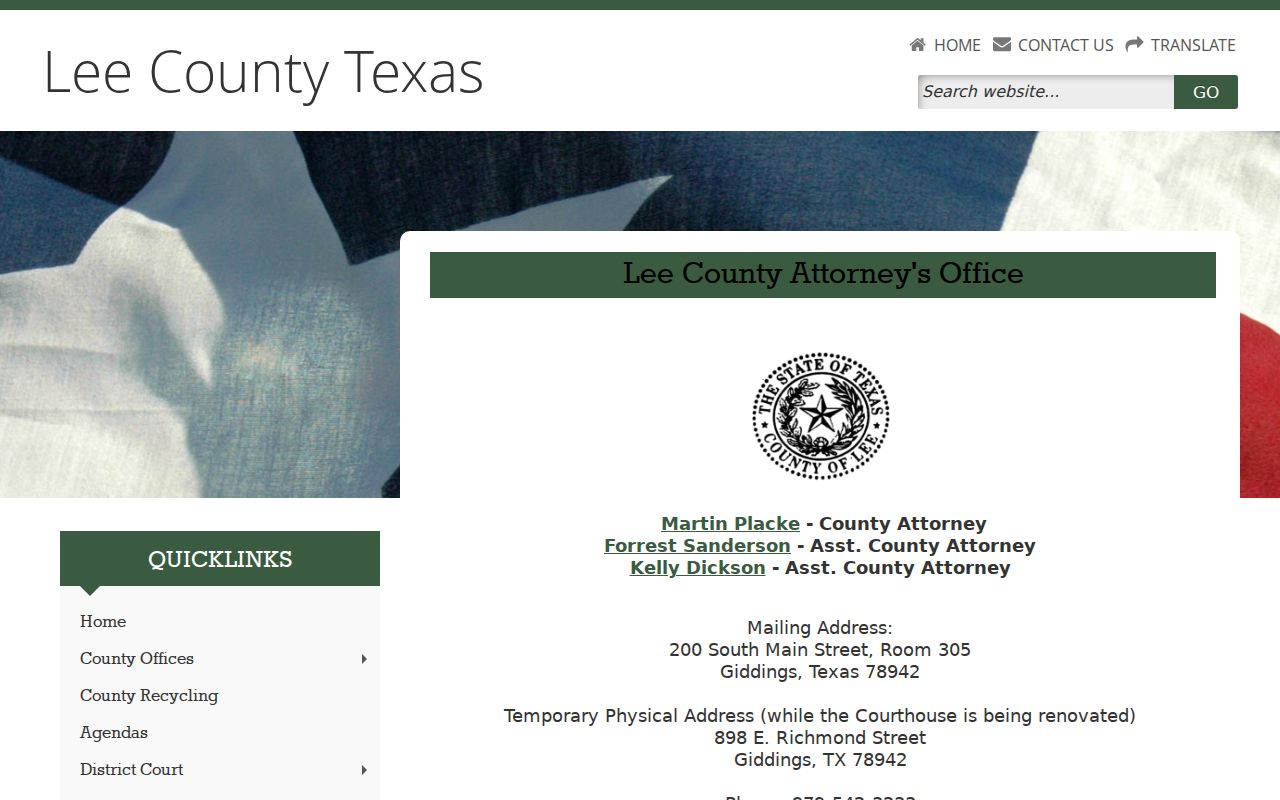
This local structure explains why the same prosecutor may appear in both a district felony file and a county misdemeanor matter.
Access & Restrictions
Court records are requested from the court clerk under judiciary access rules, not treated exactly like a sheriff report under the Texas Public Information Act. Public access can still be limited by expunction, nondisclosure, juvenile confidentiality, sealed filings, victim protections, and redaction of sensitive identifiers. An online view may show less than the clerk's file, and the clerk may need time to locate an older or archived record.
Ask for named documents and a cause number when possible. “Docket sheet, charging instrument, signed judgment, and sentence” is clearer than a request for every record about a person. The District Clerk accepts credit-card arrangements by phone for eligible charges and lists major card brands, but a vendor convenience fee applies. Confirm the current copy and certification cost before ordering because the research does not establish one flat price for every criminal document.
Lee County Court Record Counters
Lee County's renovation makes “go to the courthouse” poor advice. Felony files are at the District Clerk in the District Court Building. County-level misdemeanor files are at the County Clerk on East Industry. The historic courthouse and Annex Building B house other functions as relocation work changes. Check the county homepage before travel and call the destination office about access, devices, or current location.
Lee County District Clerk
289 S. Main St.
Giddings, TX 78942
979-542-2947
Monday-Friday, 8 a.m.-noon and 1-5 p.m.
Lee County Clerk
843 E. Industry
Giddings, TX 78942
979-542-3684
Monday-Friday, 8 a.m.-5 p.m.
The Giddings Police Department page represents the city-law-enforcement branch whose fine-only cases can lead to a separate municipal court record.
A city officer's report remains with the city, while the resulting court file must be obtained from the court that received the charge.